


The Invisible Triad: The Hidden Links Between Fibromyalgia, ADHD, and Trauma

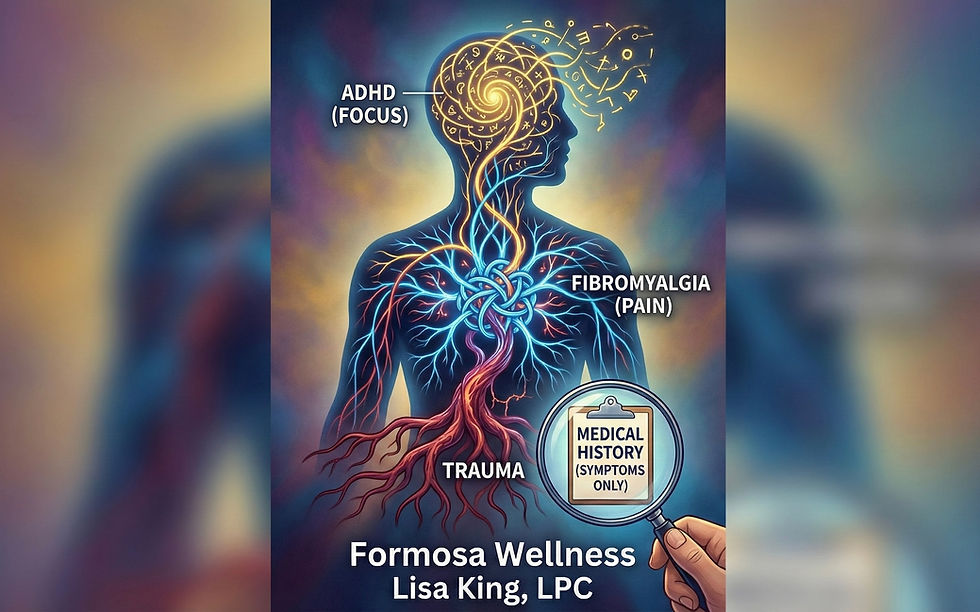
If you live with chronic pain, struggle with focus, and carry the weight of a difficult past, you might feel like you are fighting three separate battles. You have an appointment for the pain, a different one for the focus, and maybe therapy for the past.
But what if these aren't three separate struggles? What if they are one physiological story of a nervous system that has learned to survive by staying on high alert?
Emerging research suggests that Fibromyalgia, ADHD, and Trauma (specifically C-PTSD) often form a "triad" of co-occurring conditions. Yet, tragically, many patients go decades without seeing the connection, largely because modern medicine rarely asks the one question that ties them all together: “What happened to you?”
The Physiology of Connection: It’s Not "All in Your Head"
To understand why these three conditions overlap, we have to look at Central Sensitization.
Imagine your nervous system has a volume knob. In a "regulated" system, the volume is at a 3 or 4—you hear important things, but background noise is ignored. In someone with a history of trauma, that volume knob gets stuck at a 10. This is hypervigilance.
• In the Body (Fibromyalgia): When the nervous system is stuck on "high," it interprets normal sensations as dangerous. A gentle touch or a change in weather registers as pain. This is central sensitization, a hallmark of fibromyalgia.
• In the Brain (ADHD): That same hyper-arousal affects executive function. The brain is scanning for threats so intensely that it cannot prioritize mundane tasks like laundry or emails. Furthermore, studies suggest a significant overlap in dopamine dysregulation between ADHD and chronic pain conditions.
• The Root (Trauma): Trauma is the engine often driving this dysregulation. When the body is trapped in a chronic "fight, flight, or freeze" response due to unresolved trauma, it fundamentally alters how the brain processes pain and attention.
Who Is Most At Risk?
While this triad can affect anyone, it appears most frequently in women and those with high ACE (Adverse Childhood Experiences) scores.
Research indicates that adults with a history of childhood maltreatment are significantly more likely to be diagnosed with fibromyalgia. Similarly, undiagnosed ADHD is increasingly found in women who present with chronic fatigue and pain syndromes, often masking their neurodivergence for years until their body "crashes" into fibromyalgia.
The Medical Blind Spot: Why Doctors Miss It
If the science connects these dots, why doesn't your doctor?
The failure often happens during the medical history intake. Standard medical training typically silos the body from the mind. A rheumatologist looks at joints; a psychiatrist looks at neurotransmitters. Rarely do they compare notes.
Furthermore, few physicians are trained in Trauma-Informed Care. When a patient presents with vague, widespread pain and difficulty concentrating, a doctor might label it as "drug-seeking" or "laziness" rather than investigating a trauma history.
They miss the connection because they are looking for a broken part, not a dysregulated system.
Crucially, medical gaslighting plays a role. Patients (especially women) reporting high pain levels and "brain fog" are often dismissed as anxious or hysterical. The doctor treats the symptom (painkillers, antidepressants) but never addresses the root cause: a nervous system that needs safety, not just sedation.
Breaking the Cycle
Understanding that your distraction (ADHD), your pain (Fibromyalgia), and your history (Trauma) are interconnected is the first step toward validation. You aren't "falling apart" in three different ways; your body is responding to a singular, systemic need for safety and regulation.
Healing often requires a multi-pronged approach that respects this connection—treating the pain, supporting the executive dysfunction, and processing the trauma safely.
References
1. The ACE Study: Felitti, V. J., et al. (1998). Relationship of childhood abuse and household dysfunction to many of the leading causes of death in adults. American Journal of Preventive Medicine. (Establishes the link between childhood trauma and later physical illness, including autoimmune and pain disorders).
2. ADHD and Fibromyalgia Comorbidity: Kasahara, S., et al. (2021). Prevalence of Attention-Deficit/Hyperactivity Disorder in Patients with Fibromyalgia. Pain Medicine. (Found that a significant percentage of Fibromyalgia patients screen positive for adult ADHD).
3. Central Sensitization & Trauma: Woolf, C. J. (2011). Central sensitization: Implications for the diagnosis and treatment of pain. Pain. (Explains the mechanism of how the nervous system becomes hypersensitive).
4. Trauma and Chronic Pain: Afari, N., et al. (2014). Psychological trauma and functional somatic syndromes: a systematic review and meta-analysis. Psychosomatic Medicine.


Comments