


The Holiday Litmus Test: Are You Expected or Anticipated?

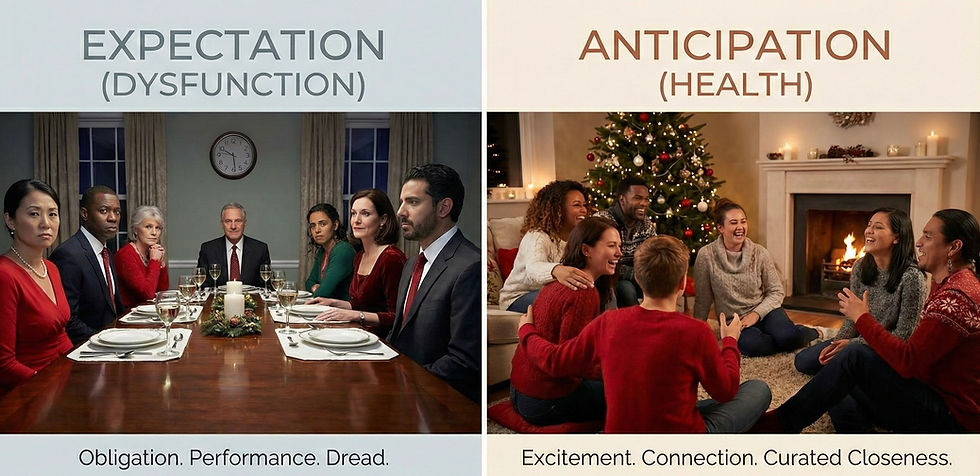
As the holidays approach, there is a specific physical sensation that acts as a barometer for the health of your family dynamics.
For some, it is a flutter of excitement—a lightness that says, "I can't wait to see them." For others, it is a heavy, calcified knot in the stomach—a dread that says, "I have to survive this."
This difference isn't just about personality types or introversion vs. extroversion. It is often the difference between two powerful relational forces:
Expectation and Anticipation.
One is a sign of deep-seated dysfunction; the other is the fruit of "Curated Closeness." Understanding the difference can be the first step in validating your own reality this holiday season.
The Weight of Expectation (Dysfunction)
In dysfunctional family systems, love is often confused with obligation. The gathering isn't a celebration of who you are; it is a performance of who you are supposed to be.
When you walk into a house built on Expectation, you are walking into a role. The family doesn't necessarily want you—the complex, messy, evolving human being. They want the version of you that keeps the boat steady.
Signs you are living in "Expectation":
• The "Show Up" Tax: You feel you must "show up a certain way" to be accepted. This might mean hiding your tattoos, softening your political views, pretending to be more religious than you are, or performing "success" to avoid criticism.
• The Dread Factor: The weeks leading up to the holiday are filled with anxiety, mental rehearsal of arguments, and a desire to numb out before you even arrive.
• Dismissiveness: If you try to share a real struggle, it is glossed over, minimized, or redirected back to how it affects them. Being "seen" is viewed as a threat to the status quo.
• Rigidity: Attendance is mandatory, not voluntary. If you say "no," it is treated as a betrayal rather than a schedule conflict.
In these environments, you aren't a person; you are a prop in the family play. The "expectation" is that you will hit your mark, say your lines, and not disrupt the illusion of harmony.
The Freedom of Anticipation (Health)
Contrast this with a family system that has invested in Curated Closeness.
This phrase—Curated Closeness—implies intention. It means the intimacy didn't just "happen"; it was built. It was built through years of safe conversations, respected boundaries, and emotional investment.
When a family cares about your well-being more than your compliance, the dynamic shifts from Expectation to Anticipation.
What "Anticipation" feels like:
• Come As You Are: You can show up tired. You can show up sad. You can show up successful or struggling. You know that your belonging is not contingent on your performance.
• Genuine Curiosity: Questions are asked to know you, not to judge you. "How are you?" is a real inquiry, not a formality.
• Emotional Safety: You don't have to armor up before entering the door. The nervous system remains regulated because there is no threat of attack or dismissal.
• Excitement vs. Obligation: Everyone is excited to gather because the space is nourishing. The "get-together" is a battery charger, not a battery drainer.
In this space, you are anticipated. Your presence is desired because of who you are, not because of the role you fill.
The "Curated Closeness" Investment
The tragedy of the holidays for many is the realization that you cannot simply will Anticipation into existence. It is the result of long-term investment.
Families that enjoy Anticipation have usually done the hard work during the other 11 months of the year:
1. They have invested in you emotionally (listening, validating, supporting).
2. They have respected your "no", making your "yes" meaningful.
3. They have prioritized connection over correction.
A Note for This Holiday Season
If you are reading this and realizing your holidays are defined by Expectation and Dread, please know this: Your anxiety is not a character flaw. It is a data point.
It is your body telling you that the environment is demanding a performance you are too tired to give.
• If you have Anticipation: Cherish it. It is rare and beautiful.
• If you have Expectation: Be gentle with yourself. You are not "bad" for dreading the performance. You are simply a human being craving to be seen, not just expected.
This year, may we all find—or create—spaces where we are anticipated, understood, and deeply, truly seen.


Comments